Ahead of the Curve: Why Parkland Properties Are Outpacing Calgary's Resale Market
In real estate, timing is everything — and in Calgary's southwest corridor, that timing increasingly points toward one community. Parkland, a master-planned neighbourhood situated along the city's southwestern edge, has quietly posted resale appreciation figures that are drawing attention from both local buyers and investment-minded observers across Alberta. The question many are now asking is not whether Parkland represents strong value, but whether that value has yet to be fully priced in.
To understand what is driving this trajectory, one must look beyond surface-level metrics and examine the structural forces shaping the community's long-term appeal.
A Market That Moves Differently
Calgary's real estate market, like most major Canadian cities, tends to move in broad cycles tied to employment, migration, and interest rate conditions. Yet within those cycles, certain neighbourhoods consistently outperform their peers — not by accident, but because of deliberate planning decisions made years or even decades earlier.
Parkland fits this pattern. According to data compiled from the Calgary Real Estate Board (CREB), select southwest communities have demonstrated five-year appreciation rates that meaningfully exceed the city's benchmark average. While broader Calgary residential prices rose approximately 18 to 22 percent over the most recent five-year window, well-positioned southwest communities — particularly those with newer master-planned infrastructure — have tracked closer to 27 to 34 percent appreciation over the same period, depending on property type and street-level positioning.
Local real estate professionals who specialize in the southwest corridor describe Parkland as occupying a particularly compelling position within this trend. "What we're seeing in Parkland isn't speculative momentum," explains one Calgary-based agent who has worked the southwest market for over a decade. "The appreciation is underpinned by genuine demand drivers — families relocating from more congested inner-ring suburbs, professionals seeking proximity to Fish Creek and the ring road network, and a limited pipeline of comparable new inventory."
The Infrastructure Dividend
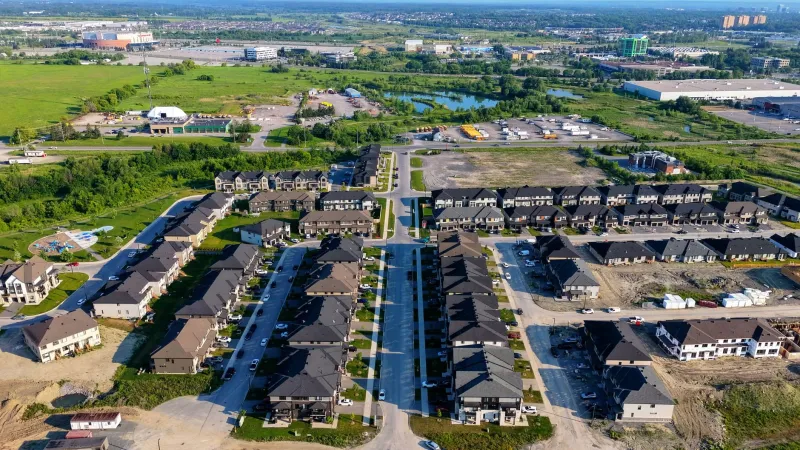
Master-planned communities carry a structural advantage that older, organically developed neighbourhoods simply cannot replicate: intentional design. Parkland's layout reflects deliberate choices about green space integration, traffic flow, school proximity, and commercial accessibility — choices that translate directly into livability, and livability translates into sustained demand.
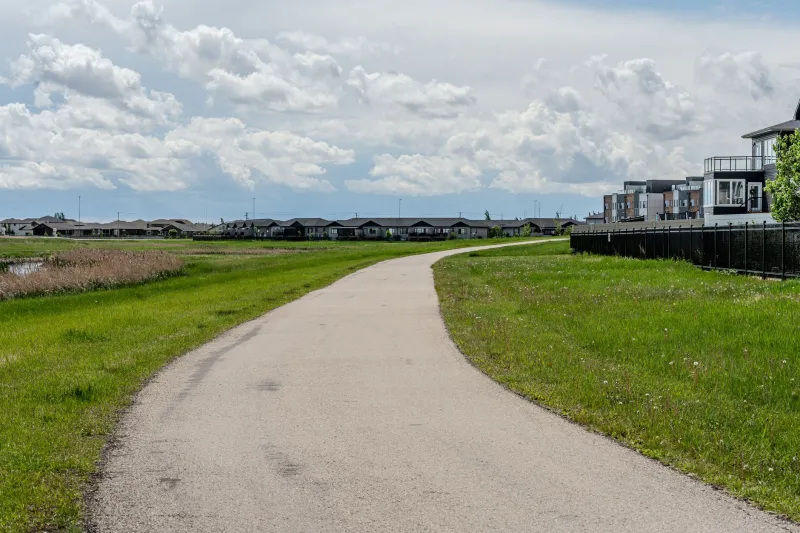
Fish Creek Provincial Park, one of Canada's largest urban parks, forms a natural boundary that enhances Parkland's environmental identity while simultaneously constraining land supply in the immediate area. This geographic circumstance is not incidental. It creates a hard ceiling on the number of comparable properties that can ever enter the market, a dynamic that structurally supports price floors even during softer market conditions.
Beyond the park, Parkland benefits from proximity to Stoney Trail and the broader ring road system, which has fundamentally altered commute patterns across Calgary's south and southwest. For buyers who work in areas such as the Beltline, downtown core, or even the southeast industrial districts, Parkland's connectivity profile is considerably more practical than its distance from the city centre might initially suggest.
Demographic Momentum in the Southwest
Calgary's population growth story has a distinct geographic dimension. Migration patterns — both from other Canadian provinces and internationally — have shown a consistent preference for the city's south and southwest quadrants. This is partly attributable to the concentration of newer housing stock, partly to the presence of strong public and separate school options, and partly to the lifestyle amenities that have clustered in these areas over the past two decades.
For Parkland specifically, the demographic profile skews toward established families and move-up buyers — households with the financial capacity to be selective, and who tend to maintain properties well and hold them for longer periods. This cohort generates a different kind of market dynamic than entry-level or investor-dominated neighbourhoods. Turnover is lower, care standards are higher, and the community's visual appeal remains consistently strong — all factors that support ongoing resale performance.
"The buyers I work with in Parkland are not impulse purchasers," notes one southwest-focused realtor. "They've done their research, they understand what they're paying for, and they're making a long-term commitment. That kind of buyer base creates a self-reinforcing quality signal in the neighbourhood."
Supply Constraints and the Scarcity Premium
In any market, price appreciation ultimately reflects the relationship between supply and demand. In Parkland's case, the supply side of that equation is structurally constrained in ways that are unlikely to change.
The community is effectively built out in terms of developable land. Unlike newer communities on Calgary's outer fringe — where developers can respond to demand by releasing additional lots — Parkland does not have a meaningful pipeline of new construction available to absorb buyer interest. When demand rises, it concentrates on a fixed pool of existing homes, and that concentration exerts upward pressure on prices.
This scarcity dynamic is further reinforced by the community's location between Fish Creek to the north and the city's outer boundary to the south. There is simply no mechanism by which supply can expand to meet demand in the conventional sense. For buyers, this is a meaningful consideration: the properties available in Parkland today represent a finite and non-renewable inventory.
Positioning Ahead of Broader Recognition
One of the more instructive patterns in Canadian real estate is the lag between when a neighbourhood's fundamentals improve and when those improvements are broadly recognized in pricing. Communities that offer genuine long-term value often appreciate gradually and then more sharply once wider market awareness catches up with underlying conditions.
Several indicators suggest Parkland may still be in the earlier phase of that recognition cycle. Search volume for southwest Calgary communities has increased steadily over the past two years, driven in part by buyers priced out of inner-city neighbourhoods and in part by the growing reputation of the southwest corridor as a lifestyle destination. As that awareness broadens, the pool of prospective buyers competing for Parkland's limited inventory is likely to deepen.
For those currently evaluating whether to enter the Parkland market, the calculus involves weighing the cost of buying now against the risk of waiting for a more favourable entry point that may not materialize. Given the structural supply constraints, the demographic tailwinds, and the community's established infrastructure quality, many observers believe the asymmetry favours early positioning.
What the Data Suggests Going Forward
No responsible analysis can guarantee future appreciation, and real estate markets are subject to macroeconomic forces that affect all communities regardless of their individual strengths. Interest rate cycles, provincial employment conditions, and national immigration policy all exert influence on Calgary's broader housing market.
That said, the characteristics that have driven Parkland's above-average performance to date — geographic scarcity, master-planned infrastructure, strong demographic demand, and proximity to major natural amenities — are durable. They do not diminish with time, and in most cases, they compound.
For buyers who prioritize long-term equity accumulation alongside immediate livability, Parkland's combination of those attributes is difficult to replicate elsewhere in Calgary. The community is not simply a place to live; it is, for many households, a considered investment in a neighbourhood whose best chapter may still be unfolding.